Cognivec · Research · Topology program
The Law of Scalars
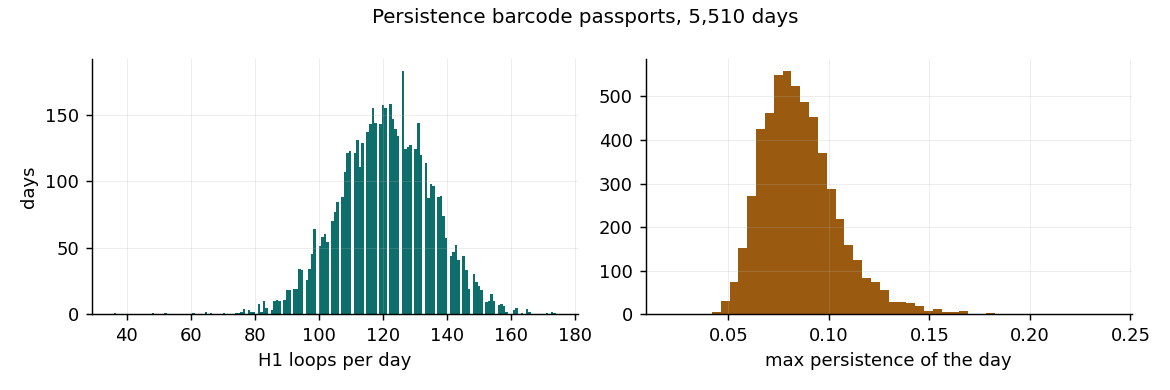
Every day of news gets a persistence passport: the full barcode of its topology — how many components exist at each resolution, at what heights they merge, how many loops the day carries, how long they persist, when the main loop is born. Ten numbers that summarize the day's shape completely. We computed the passport for 5,510 consecutive days.
A typical day carries a median of 121 loop intervals in its barcode (persistence entropy ≈ 4.4) — of which only a handful persist long enough to mean anything. The distribution is stable across fifteen years: the shape of a news day is a robust, measurable object.
The result: every scalar is market-silent
Each passport feature was tested against next-day GBPUSD return and absolute return, with placebo bands from calendar shifts. The outcome is uniform:
| feature | corr with next-day return | 95% placebo band |
|---|---|---|
| loop count | +0.002 | ±0.032 |
| persistence entropy | +0.005 | ±0.031 |
| max persistence | −0.016 | ±0.028 |
| total persistence | −0.001 | ±0.029 |
| main-loop birth | −0.011 | ±0.034 |
| merge height (median) | +0.009 | ±0.033 |
All ten features, both targets, all inside the bands. The same verdict held for the Morse-landscape scalars (basins, saddles, linking) and for the transport cost (W1).
Why this is a law, not a failure
Across our entire program the pattern repeats without exception: scalar summaries of news geometry never predict the market; only oriented constructions ever do. Magnitudes — how big, how many, how entangled — are market-silent. Directions — which way the structure points — are where every surviving signal in the FX dossier lives. A day's geometry is loud about what the news is doing and silent about which way prices go, unless you ask an explicitly directional question.