Cognivec · Research · Topology program
Basins of the News
Fifteen years of daily news, each day segmented like a mountain landscape: the day's word cloud becomes a density surface, its peaks are the day's topic capitals, its basins are their watersheds, and its saddles are the passes through which one theme flows into another — every one of them named in ordinary words. On top of the landscape we track the day's loops (circuits of meaning) and whether those loops are linked through each other like chain rings.
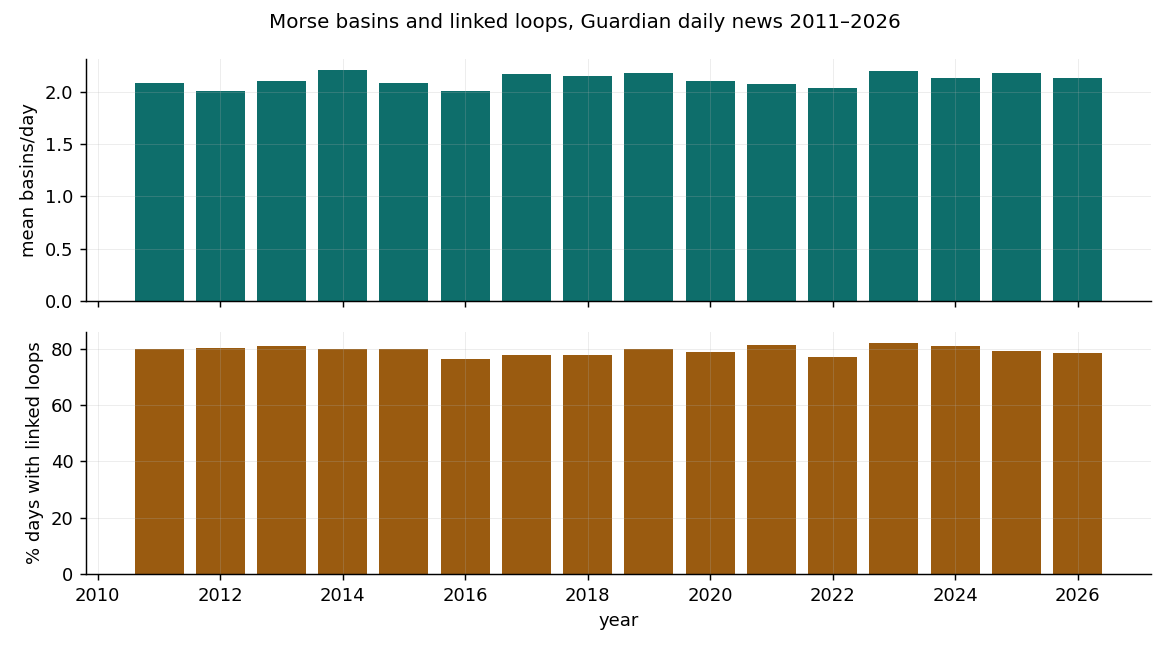
5,510 days of Guardian coverage, 2011–2026. A typical day has 2.1 basins and about 500 saddles; the busiest day carried six basins.
Two days worth telling
The day after Brexit — one single basin
24 June 2016: all 250 words of the day fall into one basin — a single funnel of density with no internal borders and no saddles, peaked at either. The referendum result collapsed the whole discourse into a monolith. Two independent instruments confirm it: the graph-connectivity view and the attention-hierarchy view see the same single block.
And the most fragmented day of the entire 15 years? 12 June 2016 — 1,716 saddles, days before the vote: maximal argument, right before maximal collapse.
The SVB hour — two basins and a named pass
10 March 2023, 15:00: the hour of the Silicon Valley Bank collapse splits into exactly two basins. The large one, peaked at year (206 words: recession, uncertain, prefer, february) — the fear of the year just begun. The small one, peaked at january (44 words: pace, gains, data, prices) — the fresh January data. The pass between them runs through months ↔ january at height 0.82: to get from fear to facts, the discourse had to climb through the calendar.
The cloud is not a cosmic web
We tested the astronomy analogy — filaments, membranes, clumps, voids — with the standard local-dimension classifier. Verdict: 99% of words live in "volume". The semantic cloud is locally isotropic and high-dimensional; narrative "filaments" turn out to be a myth, at least in absolute thresholds. An honest negative with content: meaning-space is built differently from the universe.
The unsayable is entangled
A typical day carries about three loops of meaning. The finding we did not expect: on 79.4% of days, at least two of the day's loops are linked — threaded through each other, so neither circuit can be closed without passing through the other. What the news circles around comes in interlocking pairs far more often than not.