Cognivec · Research · Topology program
The Weather of Meaning
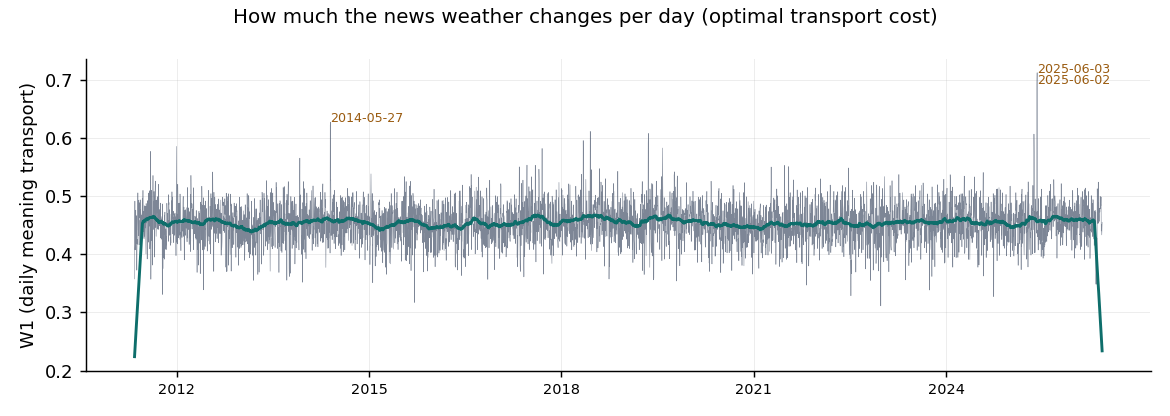
The first truly dynamic geometry in our program: treat two consecutive days of news as two clouds of meaning, and solve the optimal-transport problem between them. The answer is a weather map — a wind vector for every word, showing where its mass was blown overnight — and a single scalar, the transport cost W1: how much the meaning-weather changed in 24 hours.
5,509 daily transitions, 2011–2026. Median daily weather change: W1 = 0.454.
The stormiest and the stillest days
- Biggest weather breaks: 1–2 June 2025 (W1 up to 0.712), 25–26 May 2014 (the European election aftermath), 14 June 2018.
- Calmest weather in fifteen years: 25 December 2022 (W1 = 0.311) — Christmas, when the news simply stops moving; then 17 September 2015 and 28 September 2024.
That Christmas is the global minimum is exactly the kind of sanity check an instrument should pass before you believe anything else it says.
Market test — reported honestly
The scalar is silent. W1 against next-day GBPUSD return and volatility: inside the 95% placebo bands, like every other scalar in this program (The Law of Scalars).
The direction is marginal — and we report it as marginal. The aggregate wind vector reaches Sharpe +0.55 (p = 0.050) frozen and net +0.27 (p = 0.09) in the strict causal protocol, with a strong-then-absent epoch split (+1.02 / −0.04). By our own standards this is not a validated signal: it is the theoretically best-motivated candidate we have — the only construction with both a direction and an arrow of time — behaving exactly like a real-but-epoch-dependent effect. It stays in the research queue, not in the dossier.